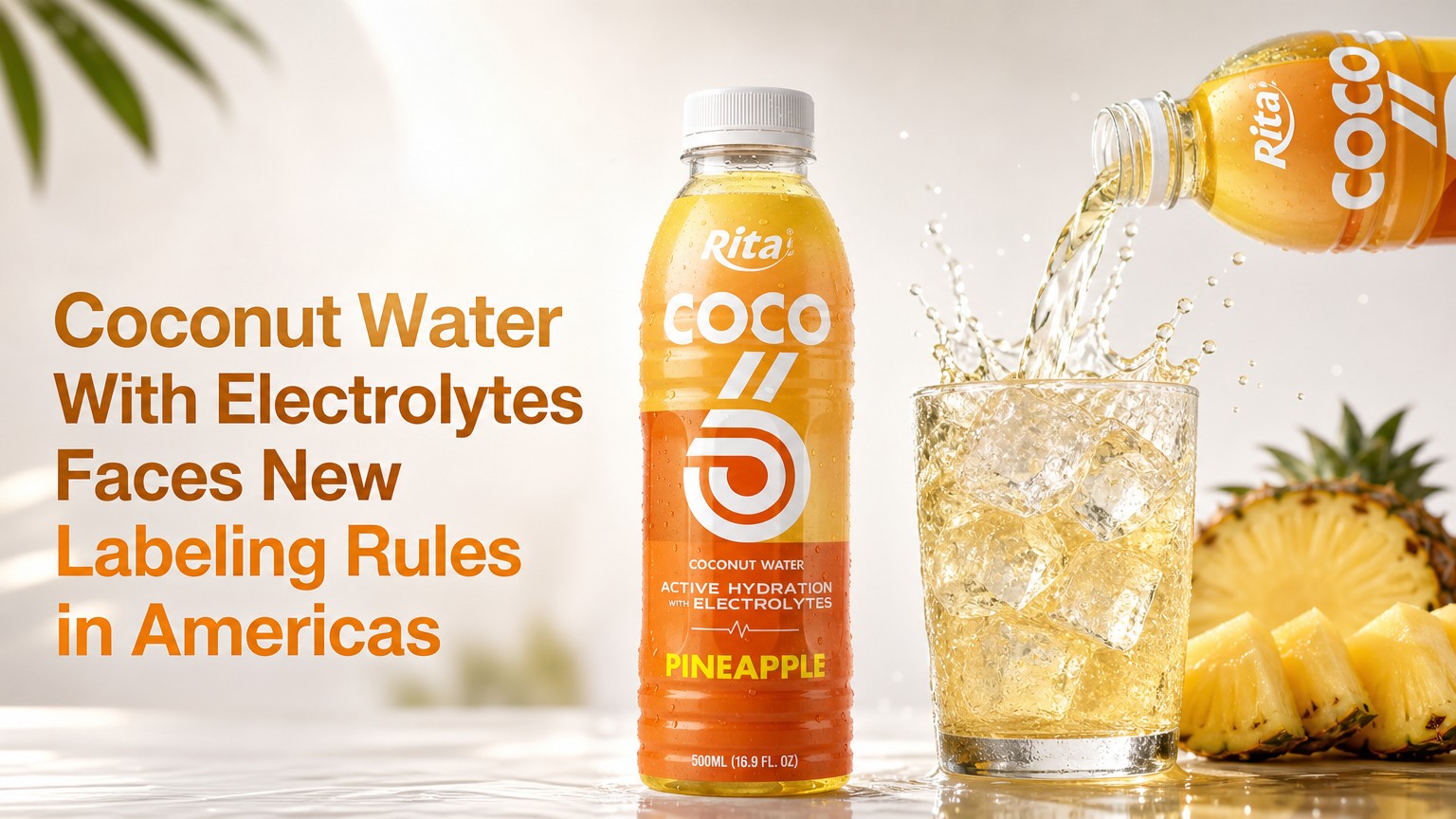
The Americas have become the most demanding destination bloc for tropical ready-to-drink beverages, and coconut water with electrolytes now sits at the intersection of that demand and a rapidly tightening rulebook. Importers from Toronto to Santiago are adding 500ml PET formats to their chillers faster than compliance teams can re-approve artwork. For Vietnamese manufacturer RITA Food and Drink Co., Ltd, which has operated since 2004 and reports exports to more than 200 countries and territories, the pineapple coconut water in its range is treated as a document-ready SKU rather than a simple refreshment. This examination of beverage export regulations follows one bottle through the approval chain that now decides whether it reaches a shelf at all.
Key Takeaways
- Destination markets apply different labeling regimes to the same 500ml PET bottle of coconut water with electrolytes.
- Front-of-pack warning systems across Chile, Mexico, Colombia, Peru and Ecuador have become a routine artwork revision step.
- Technical readings such as 6.4°Brix, pH 4.1 and declared mineral figures now appear in supplier qualification questionnaires.
- RITA pairs BRC, FSSC 22000, HACCP, Halal, Kosher, ISO, GMP and SMETA certifications with large-scale export capacity.
- Single-serve PET packaging continues to win placement in convenience, travel retail and sport-adjacent channels.
Coconut Water With Electrolytes Under a Stricter Regulatory Lens
Regulators across the hemisphere have quietly moved tropical drinks out of the simple refreshment category.
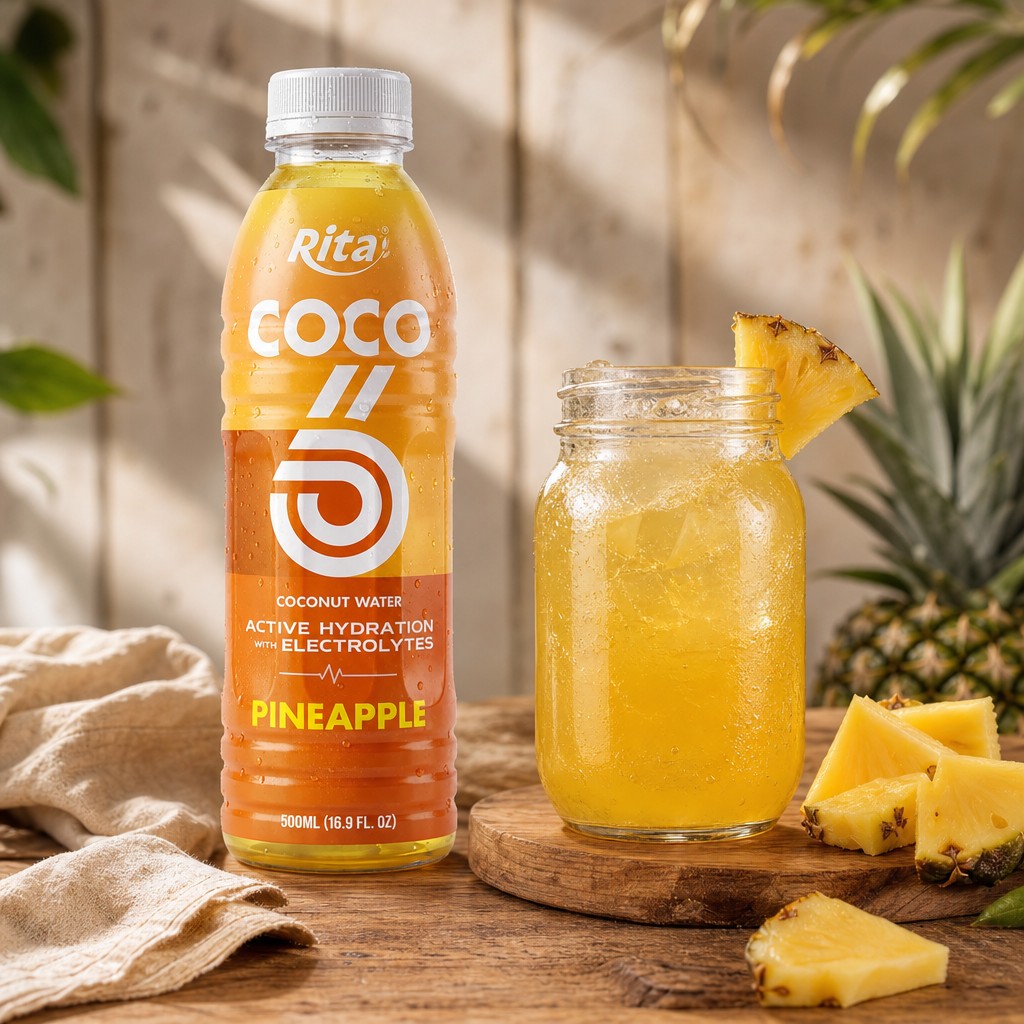
The coconut water with electrolytes in a 500ml PET bottle shows exactly why that shift matters. Its transparent body reveals a translucent golden-orange liquid, the white screw cap closes over a tamper band, and the orange-to-yellow gradient label prints a volume statement of 500mL (16.9 FL OZ), a flavor name, an ingredient list, mineral figures and vitamin declarations. Each of those elements is read differently by a US filer, a bilingual Canadian auditor and a Latin American inspector, which is why beverage import requirements now get discussed at the artwork stage instead of after the container sails. Relabeling a shipment already in transit costs far more than one additional round of design review ever will.
United States entry file and importer obligations
US-bound volume clears through prior notice filing, foreign facility registration and a foreign supplier verification programme led by the domestic importer. The product files as a beverage, while the added B5 and B3 vitamins pull nutrient declarations into the facts panel conversation.
The ingredient declaration itself is compact but specific: coconut water base, potassium chloride, sodium lactate, salt, calcium chloride, magnesium chloride, phosphoric acid, pineapple flavor, citric acid, preservatives, sucralose, colours and vitamins B5 and B3. Common naming rules apply to the preservative and the sweetener, colour additives must sit on the permitted list, and any front-panel wording has to reconcile with the back-panel declaration. Operations at RITA beverage manufacturer scale, backed by more than 50 automated production lines and roughly 1,200 containers shipped each month, keep artwork versions separated by destination so that reconciliation happens inside the factory rather than at the port. Allergen statements, specification sheets and supplier letters travel in the same dossier.
Front-of-pack systems reshaping Latin American labels
Latin American regulators moved first on front-of-pack warnings, and North American buyers now watch the same playbook.
| Market | Authority | Label item buyers most often request |
|---|---|---|
| United States | FDA | Common ingredient names, nutrition facts, prior notice filing |
| Canada | CFIA | English and French declarations sharing the same panel |
| Mexico | COFEPRIS | Front-of-pack warning seals under the NOM-051 framework |
| Brazil | ANVISA | Nutrition box in the Mercosur aligned format |
| Chile | Chilean health authority | Black octagon warnings triggered by threshold tests |
| Colombia | INVIMA | Warning octagons and sugar threshold calculations |
| Peru and Ecuador | National health authorities | Warning seals plus a complete Spanish-language back panel |
This overview of Latin America beverage labeling is compiled from public rule summaries; importers should confirm the current version of every measure with local counsel before print approval.
At 6.4°Brix and a pH of 4.1, the formulation sits low on the sweetness scale, which gives label designers room to work. The mineral additions still place sodium and potassium figures on the panel, however, and those numbers are the first line a Chilean or Colombian inspector reads. Printed volume, lot coding and expiry dating also have to stay legible after condensation, a practical point for a bottle that will spend its life in a chilled cabinet under fluorescent light.
Reading the Label on a 500ml PET Export Format
Packaging here is a regulatory statement as much as a design choice.
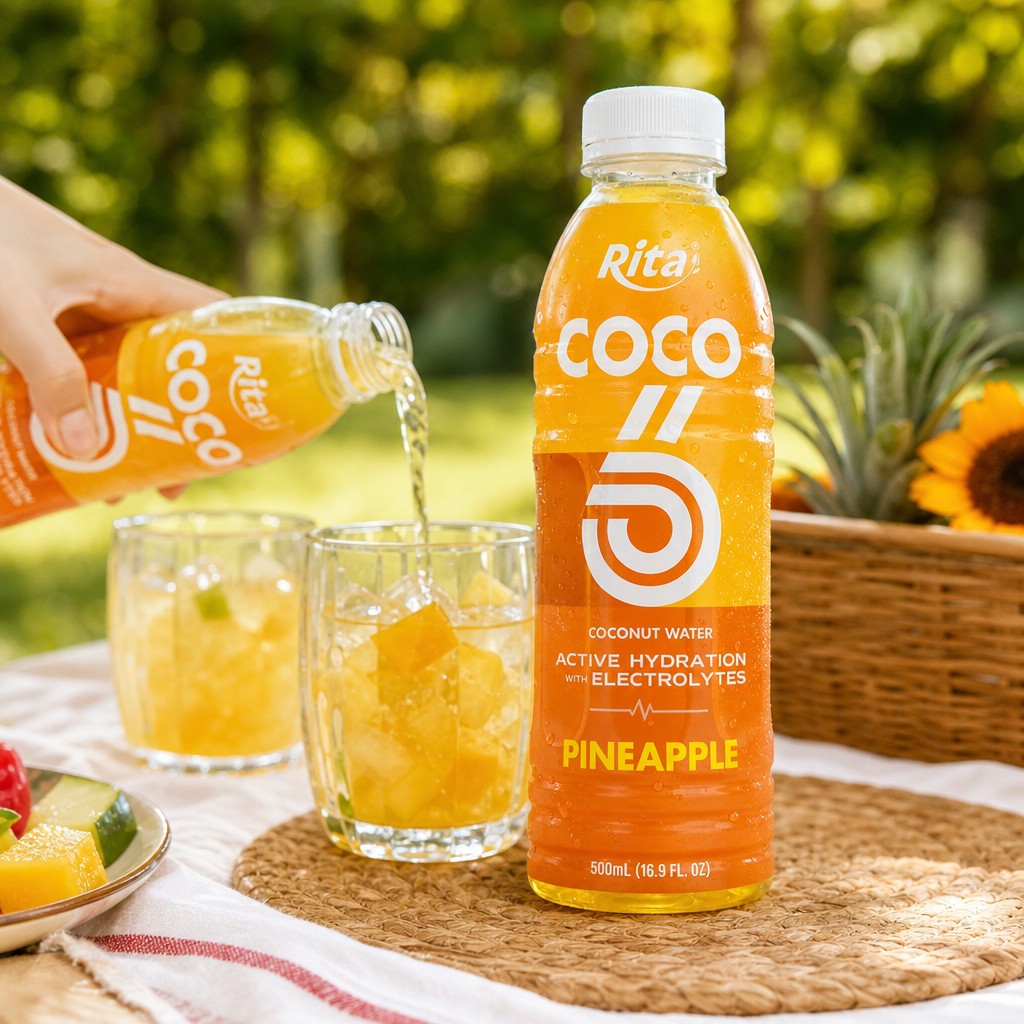
The full specification for the 500ml Coconut Water With Electrolytes And Pineapple Flavor PET Bottle reads like a compliance checklist: exact 500ml fill, PET body, screw closure, 18-month shelf life under proper storage, and loading at Ho Chi Minh Port in Vietnam. Buyers evaluating this PET bottle coconut water format tend to ask three questions in sequence — what is declared, how it prints on a curved surface, and whether the same artwork can survive a market change without a full redesign.
Flavor profile and technical readings
The drinking experience is built on a bright, lightly sweet profile rather than a heavy one. Coconut water supplies the clean base while pineapple flavor lifts the top note, producing a tropical impression that reads well in blind panels with consumers accustomed to mango, guava and passion fruit references. Acidity from citric and phosphoric acids keeps the finish crisp.
Declared readings give the sensory description a backbone: 151mg of potassium and 8mg of magnesium per 100ml, 6.4°Brix, pH 4.1, plus sucralose as the sweetener and vitamins B3 and B5 on the label. Batch-to-batch consistency on those figures is what allows an importer to keep one set of printed panels across a full year of purchase orders, and it is the first item on any incoming quality checklist.
Packaging integrity and shelf life
PET is lightweight, shippable and compatible with the curbside recovery streams that most Canadian, US and Mexican programs already accept, which helps the format clear retailer packaging scorecards. The 18-month shelf life gives distributors a workable rotation window for sea freight and warehouse storage.
Light weight also lowers freight cost per unit, a number buyers across Central America track closely when comparing PET against glass.
From Our Orchards: Coconut and Pineapple Sourcing
Raw material traceability starts well before any label is printed. The coconut water used in this line is linked to RITA's established Ben Tre coconut farm programme, which documents the route from plantation through to finished product.
The tropical top note follows a parallel path, developed through the company's pineapple sourcing programme in Vietnam, where harvest timing is used to hold the flavor profile steady across production windows.
A short field film shows the coconut material area in context at https://www.youtube.com/watch?v=I7hlTL3FT_0
Both sourcing lines feed the same lot-record system, so a printed batch code on a bottle can be traced back through intake records, blending sheets and finished-goods release. For auditors working under BRC or FSSC 22000 schemes, that chain is the difference between a sample visit and a passed inspection.
Export Positioning Across the Americas
Demand for single-serve tropical drinks in the region keeps growing, but the commercial case now depends on paperwork as much as taste.
The wider beverage sector is sending mixed signals. The National Association of Beverage Control Associations reported continued weakness in US spirits sales, spirits group Anora finalised Bacardi distribution agreements in Sweden and Norway, Constellation Group reinvested in the social tonic brand Hiyo, TKC Distilling replaced its chief executive, and Scottish distillery GlenWyvis entered administration. Read together, the stories show capital still moving toward beverage categories with clear positioning while legacy operators absorb operational headwinds.
For a coconut water with electrolytes in PET, the practical translation is straightforward. Buyers ask which markets the artwork already covers, whether the specification sheet matches the declared values, and how quickly a revised panel can be produced when a new front-of-pack rule takes effect. Availability of documentation is now a competitive differentiator alongside price.
| Destination | Label language | Typical channel |
|---|---|---|
| Canada | English and French | Grocery, convenience, club |
| United States | English, Spanish in selected chains | Convenience, mass, e-commerce |
| Mexico | Spanish | Convenience chains, supermarkets |
| Brazil | Portuguese | Hypermarkets, marketplaces |
| Colombia, Peru, Chile, Ecuador | Spanish | Supermarkets, distributors |
| Central America | Spanish | Regional distributors, tourism retail |
Shippers ordering the 500ml Coconut Water With Electrolytes And Pineapple Flavor PET Bottle typically combine several destinations in a single production run, which only works when label files are maintained per market rather than per container.
Certification Evidence and Buyer Due Diligence
Auditors rarely ask for marketing material; they ask for certificates.
The certification set attached to this product line covers BRC, FSSC 22000, Halal Jakim, Halal HCA-GCC, Kosher, ISO, GMP, HACCP and SMETA, which maps neatly onto the documents US, Canadian and Latin American importers request during onboarding. Buyers reviewing the wider range can compare formats and pack sizes in the coconut products catalogue on juicevn, while the manufacturer's own coconut products catalogue at RITA lists the fuller export lineup including cans, glass and PET options. Private label coconut water programmes are handled through the same OEM and ODM service structure, with artwork, sweetener system and vitamin premix adjusted to the buyer's brief.
A typical qualification sequence looks like this:
- Certificate pack requested and expiry dates verified against the shipment window.
- Specification sheet compared with the declared values printed on the label.
- Artwork proof checked against the destination market's front-of-pack rules.
- Shelf life, lot coding and date format confirmed for the receiving warehouse.
- Container loading plan reviewed against port of entry and distributor lead time.
Completing that sequence before production starts is what allows a 500ml PET shipment to land, clear and list without a hold. For suppliers serving the Americas, regulatory readiness has become the quiet infrastructure behind every successful launch.
Frequently Asked Questions
What regulations apply when exporting coconut water with electrolytes to the United States
Shipments are filed through prior notice, the foreign facility must be registered, and the US importer leads a foreign supplier verification programme. The label needs common ingredient names, a nutrition facts panel and compliant colour and sweetener declarations.
Do Latin American markets require front-of-pack warnings on this 500ml PET bottle
Chile, Mexico, Colombia, Peru and Ecuador operate warning or seal systems based on nutrient thresholds. At 6.4 degrees Brix the sugar figure is low, but mineral values still have to be declared and the artwork should be checked against the current version of each rule before printing.
Which certifications support buyer audits for this product
The line is produced under BRC, FSSC 22000, Halal Jakim, Halal HCA-GCC, Kosher, ISO, GMP, HACCP and SMETA certifications, which cover the documents most importers request during supplier onboarding.
What is the packaging specification and shelf life
The product is a 500ml fill in a PET bottle with a screw closure, loaded at Ho Chi Minh Port in Vietnam, and carries an 18-month shelf life when stored under proper conditions.
Can the flavor and label be adapted for private label buyers
Yes. OEM and ODM programmes allow the sweetener system, vitamin premix, flavor profile and artwork to be adjusted to the buyer's brief while keeping the same certification base.


 No.08, Thong Nhat Boulevard,