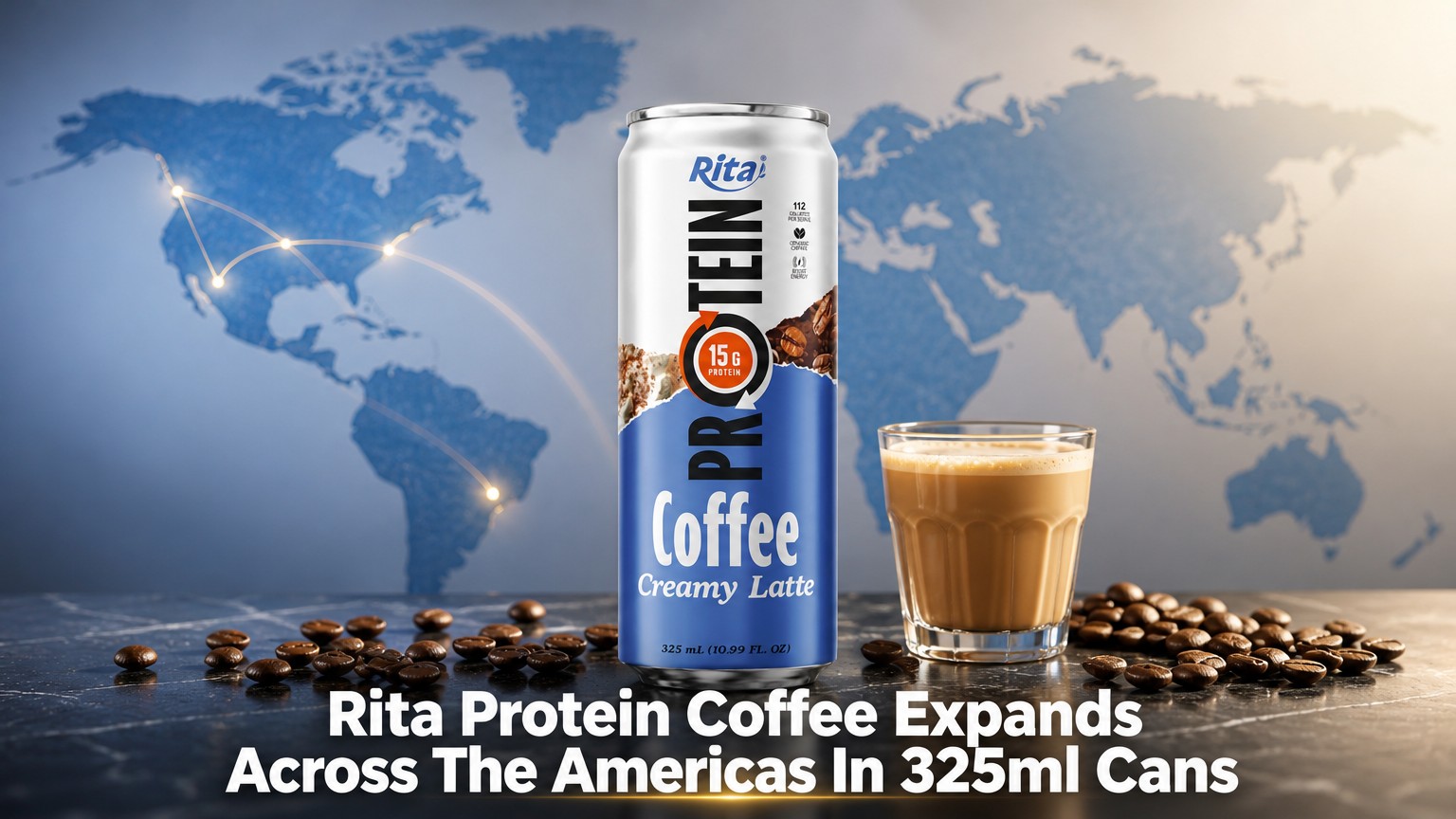
Ready-to-drink coffee continues to gain shelf space across North and South America, and one Vietnamese manufacturer is positioning itself squarely in the middle of that shift. Rita Protein Coffee 15g, a ready-to-drink high protein coffee creamy latte sold in a 325ml aluminum can, is being offered to importers, distributors, and private-label buyers throughout the Americas by RITA Food and Drink Co., Ltd, a Hanoi-based OEM/ODM beverage manufacturer with more than two decades of export experience.
Key Takeaways
- Rita Protein Coffee 15g combines 15g of protein with a creamy latte flavor in a convenient 325ml aluminum can format.
- RITA exports to more than 200 countries and territories and holds BRC, FSSC 22000, Halal, Kosher, ISO, GMP, HACCP, and SMETA certifications.
- Protein-enriched RTD coffee is a fast-growing sub-segment as consumers across the Americas seek convenient, protein-forward beverages.
- The 24-month shelf life and durable aluminum packaging make the product well suited to long-distance shipping and tropical distribution conditions.
- OEM and private-label buyers can customize formulation and packaging through RITA's coffee drinks program.
Protein Coffee Market Momentum In The Americas
Protein-enriched beverages have moved from niche gym coolers to mainstream convenience-store coolers, and coffee is riding the same wave.
Across the United States, Canada, Mexico, Brazil, Colombia, Chile, Peru, and Argentina, retailers are reporting stronger demand for drinks that combine familiar coffee flavor with a meaningful protein count. The appeal is straightforward: a single can delivers a creamy latte experience alongside 15g of protein, without requiring preparation or refrigeration before opening. For busy professionals and fitness-minded consumers alike, the ready-to-drink format removes friction from the daily routine.
The category sits at the intersection of two durable consumer trends. Coffee remains one of the most consumed beverages worldwide, while protein fortification has expanded well beyond sports nutrition into mainstream dairy, juice, and plant-based lines. When manufacturers merge the two, the result is a product that reads as both an indulgence and a practical choice, a combination that travels well across very different retail environments, from New York bodegas to Santiago vending machines.
For distributors, the timing matters. Retail buyers in the region are actively refreshing their RTD coffee assortments, and protein variants offer a point of differentiation against the crowded field of standard lattes and cold brews. Products that arrive in durable, visually distinctive packaging and carry credible third-party certifications tend to move faster through category reviews.
Analysts covering the non-alcoholic beverage space have noted that protein RTD drinks are no longer confined to a single demographic. The format appeals to commuters grabbing a morning option, office workers looking for an afternoon pick-me-up, and younger consumers who discover products first on e-commerce platforms. That breadth of appeal is one reason manufacturers are investing in coffee-based protein lines rather than treating them as seasonal experiments.
Inside The Product And Its Formulation
Rita Protein Coffee Creamy Latte is built around a straightforward ingredient profile designed for consistency across large production runs.
Protein Blend And Coffee Base
Each 325ml can delivers 15g of protein sourced from a blend of whole milk powder and milk protein concentrate. The coffee character comes from instant coffee powder, supported by artificial coffee flavor, emulsifiers, and stabilizers that keep the texture smooth and uniform from the first pour to the last sip. Caffeine content is calibrated at approximately 62mg per can, a moderate level that sits comfortably below a typical espresso-based drink while still reading clearly as coffee.
Calorie counts land in the range of roughly 112 to 183 calories per serving, depending on formulation variant, giving brand owners flexibility to position the drink toward lighter or more indulgent profiles. The flavor itself leans rich and milky, with a rounded latte sweetness and low bitterness, a profile that tests well with consumers who find black coffee too sharp.
Shelf Life And Storage
The aluminum can supports a 24-month shelf life when stored in cool, dry conditions, a specification that matters enormously for importers shipping across long ocean routes or distributing through warehouses in warmer climates. Stability over two years reduces write-offs and gives buyers confidence to order container loads rather than small trial quantities.
Packaging And Export Advantages For Global Distribution
The 325ml aluminum can is both a design statement and a logistics asset.
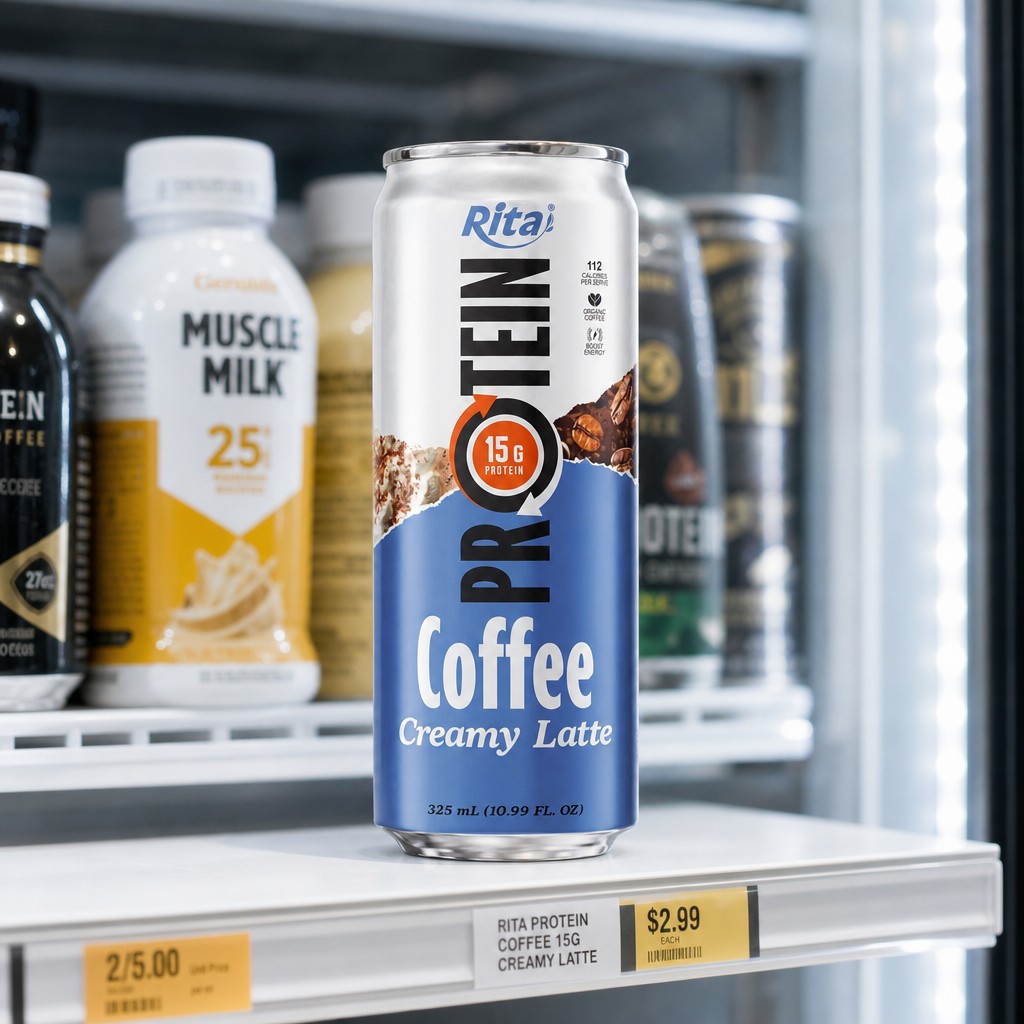
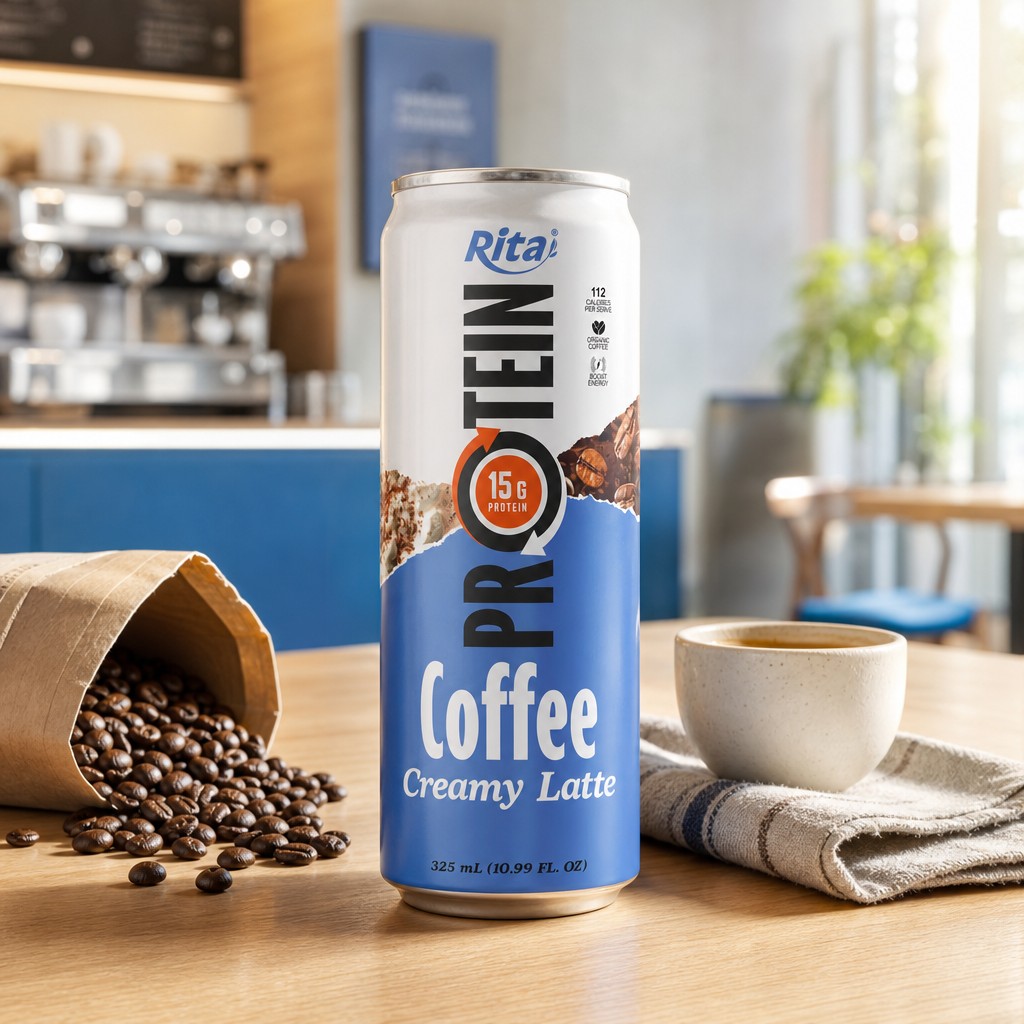
Visually, the packaging uses a white-and-blue color scheme with bold vertical PROTEIN lettering, an orange circular badge calling out 15G PROTEIN, and roasted coffee bean imagery paired with a creamy latte swirl. Additional on-can callouts reference 112 calories per serve and the 325 mL (10.99 FL. OZ) volume. The result is a product that stands out on a refrigerated shelf, in a vending machine column, or as a thumbnail on an e-commerce listing, three environments where first impressions decide velocity.
Structurally, aluminum offers crush resistance and light protection that PET and carton alternatives struggle to match over multi-week ocean transit. For exporters moving product from Southeast Asia to ports in Long Beach, Santos, Callao, or Veracruz, that durability translates directly into fewer damaged units and more predictable claims handling.
Certifications That Clear Customs And Category Reviews
RITA's production is certified under BRC, FSSC 22000, Halal Jakim, Halal HCA-GCC, Kosher, ISO, GMP, HACCP, and SMETA schemes. For buyers in Latin America and North America, these credentials shorten the due-diligence cycle during supplier onboarding. Halal and Kosher coverage additionally opens doors to specialty retail channels and export corridors in the Middle East, should a brand wish to extend the same SKU beyond the Americas.
The company operates more than 50 automated production lines and ships over 1,200 containers per month across its portfolio, which includes tropical fruit juices, coconut products, functional drinks, energy drinks, and coffee beverages. That scale gives importers confidence that reorder cycles will not stall after an initial container is sold through. Buyers interested in the broader catalog can review the full coffee drinks lineup on RITA's corporate site.
Export Infrastructure And Market Reach Across The Americas
RITA Food and Drink Co., Ltd, established in 2004, has built its export business around consistent quality systems rather than one-off spot shipments. The company supplies brands in more than 180 countries and has expanded that footprint to over 200 countries and territories in recent reporting. Its portfolio spans aluminum cans, glass bottles, PET, and PP formats, allowing buyers to consolidate multiple SKUs with a single supplier.
For the Americas specifically, that infrastructure matters. Importers in the United States and Canada typically require documentation packages that satisfy FDA and CFIA expectations, while buyers in Brazil and Argentina navigate ANVISA and SENASA requirements. A manufacturer already fluent in international certification regimes shortens the path from first sample to first commercial invoice.
Private-label programs add another layer of opportunity. Brands looking to launch a protein coffee line without building formulation and packaging capability from scratch can work with RITA's OEM and ODM teams to adapt flavor profiles, protein levels, and can artwork to local preferences. Details on that service are available through the company's OEM service program.
Raw Material Sourcing And Quality Foundations
Consistent taste at scale begins upstream, and RITA has invested in sourcing relationships that support repeatable flavor profiles across production runs.
The company maintains direct ties to growing regions in Vietnam, including its coffee gardens in Vietnam's Central Highlands during peak harvest season, where raw coffee material is evaluated before it enters the supply chain. Those inspections help the procurement team match bean lots to the flavor targets specified for RTD coffee formulations.
Dairy inputs follow a similar discipline. Milk powder and milk protein concentrate are sourced against fixed specification sheets, with incoming lots checked for protein content, solubility, and flavor neutrality before blending. The objective is simple: a consumer in Mexico City and a consumer in Toronto should taste the same latte.
Broader agricultural sourcing draws on the Mekong Delta raw material region, which supplies fruit and botanical inputs used across RITA's wider beverage catalog. Together, these sourcing programs underpin the company's ability to offer both standardized SKUs and customized formulations to buyers in the region.
Competitive Landscape And Category Signals
The broader beverage industry is in an active investment cycle, and several recent moves offer context for where protein coffee may fit.
Shepherd Neame has announced plans to open a brewery dedicated to its own brand portfolio, a signal that established players are doubling down on controlled production capacity rather than relying solely on co-packing. Varun Beverages, meanwhile, will build another manufacturing plant in India to expand capacity, underscoring how RTD players are racing to add volume ahead of demand. On the packaging side, Innocent Drinks is testing edible seaweed pods as a sustainable alternative, a reminder that material innovation remains a live battleground even as aluminum retains strong advantages for long-haul export.
Not every headline is celebratory. India's duty-free sugar quota is expected to provide only modest relief for beverage makers facing supply constraints, and Sazerac drew criticism for an ice-cream van promotional stunt, illustrating how brand messaging missteps can attract outsized scrutiny. For exporters, the takeaway is that operational reliability and clear positioning matter as much as marketing flair.
Within that landscape, a protein coffee SKU with verified certifications, a two-year shelf life, and a visually distinctive can offers distributors a product story that is easy to explain at the shelf and easy to defend during category reviews.
Opportunities For Distributors And Private-Label Buyers
Several factors make Rita Protein Coffee a practical candidate for regional distribution programs.
- Format readiness. The 325ml can is a standard size for single-serve retail, vending, and foodservice channels across the Americas.
- Protein positioning. At 15g per can, the product meets the protein threshold consumers associate with a meaningful serving, without pushing calorie counts into heavy-meal territory.
- Flavor accessibility. A creamy latte profile with moderate bitterness broadens appeal beyond specialty-coffee drinkers.
- Customization paths. Buyers can adjust protein levels, sweetness, and artwork through RITA's OEM and ODM programs to match local taste preferences.
- Supply continuity. With 50+ production lines and 1,200+ containers shipped monthly, reorder risk is managed at scale.
Buyers who want to see the broader ready-to-drink coffee assortment can browse the coffee drink series catalog, while those evaluating the specific SKU will find full specifications on the Rita Protein Coffee 15g product page.
For retail category managers, the product also slots cleanly into existing planograms. It sits naturally beside cold brew lattes, dairy-based protein shakes, and energy drinks, allowing retailers to merchandise a protein-coffee block without redesigning shelf sets.
Looking Ahead
Ready-to-drink coffee is no longer a seasonal curiosity; it is a structural category with room for differentiated formats. Protein-enriched variants represent one of the clearest avenues for brands to stand apart as standard lattes and cold brews multiply.
For importers and distributors across Canada, Mexico, Brazil, Argentina, Colombia, Chile, Peru, the United States, Ecuador, Venezuela, and Central America, the combination of a proven formulation, durable packaging, recognized certifications, and a manufacturer with two decades of export history reduces the typical risk profile of a new SKU introduction. Additional product details and specifications are available on the Rita Protein Coffee 15g listing.
As the category matures, expect more entrants, sharper price competition, and continued innovation in packaging and flavor. Suppliers who can pair consistent quality with export-ready logistics will be best positioned to win the next round of retail listings.
Frequently Asked Questions
What protein content does Rita Protein Coffee 15g deliver per can?
Each 325ml can contains 15g of protein from a blend of whole milk powder and milk protein concentrate, combined with instant coffee powder for a creamy latte flavor.
What is the shelf life of Rita Protein Coffee in the 325ml aluminum can?
The aluminum can format supports a 24-month shelf life when stored in cool, dry conditions, making it suitable for long-distance ocean shipping and distribution in warm climates.
Which certifications does RITA hold for export markets?
RITA holds BRC, FSSC 22000, Halal Jakim, Halal HCA-GCC, Kosher, ISO, GMP, HACCP, and SMETA certifications, supporting import requirements across the Americas and other regions.
Can buyers customize Rita Protein Coffee for private label?
Yes. RITA offers OEM and ODM programs that allow buyers to adjust formulation, protein level, flavor profile, and can artwork to match local market preferences.
How much caffeine is in one 325ml can of Rita Protein Coffee?
Each can contains approximately 62mg of caffeine, a moderate level that provides a clear coffee character without excessive intensity.


 No.08, Thong Nhat Boulevard,