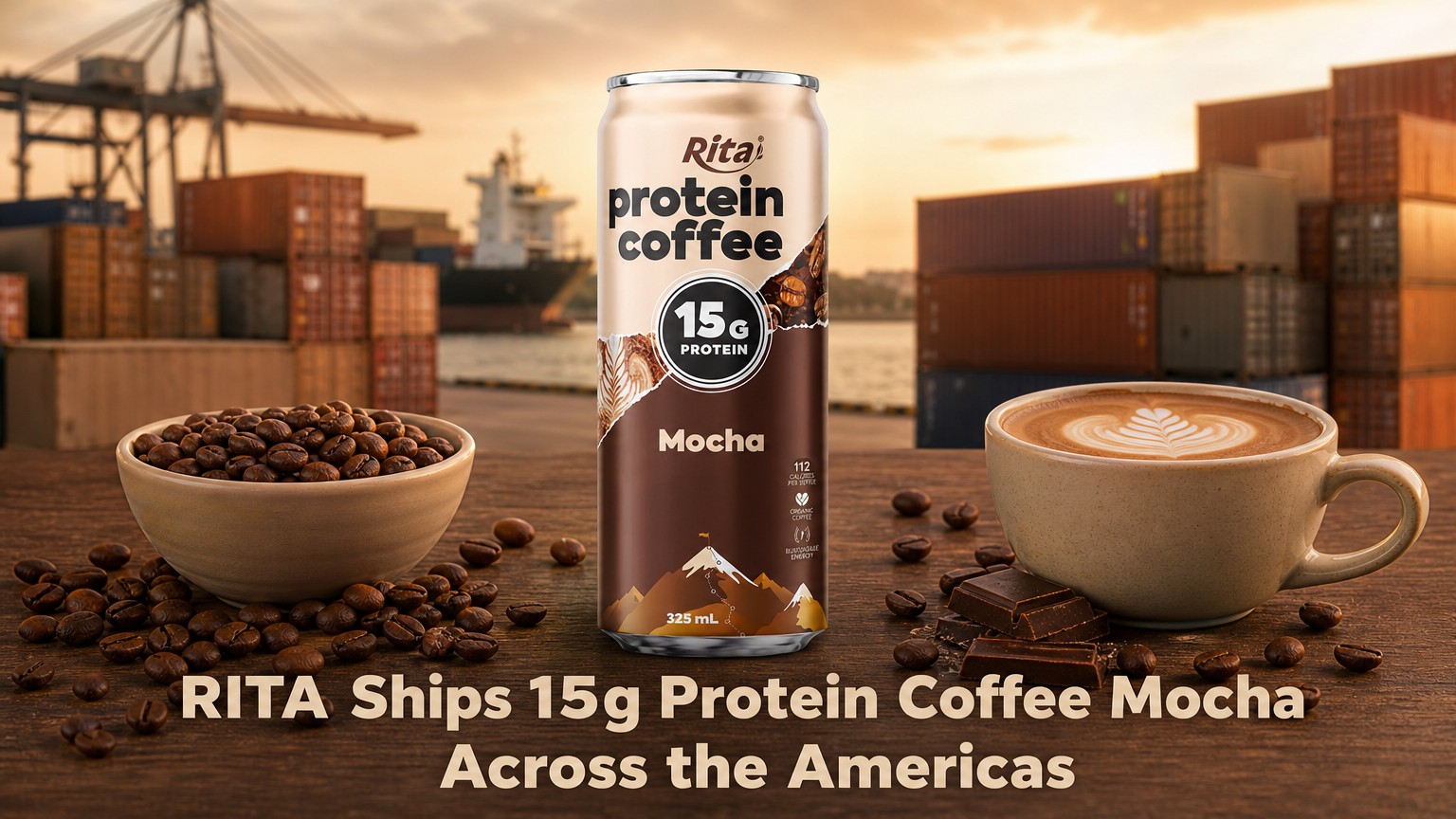
The ready-to-drink coffee aisle across North and Latin America is getting a new entrant built for scale. RITA High Protein Coffee Mocha Drink, a 325ml aluminum can delivering roughly 15 grams of protein alongside 91mg of caffeine, is being positioned for distribution throughout the Americas, from the United States and Canada down through Mexico, Colombia, Brazil, Argentina, Chile, Peru, Ecuador, Venezuela, and Central America. Behind the product sits a supply chain machinery that has been refining export logistics for two decades.
Key Takeaways
- RITA Food and Drink Co., Ltd operates 50+ automated production lines and ships more than 1,200 containers per month to over 200 countries and territories.
- The High Protein Coffee Mocha combines a 15g protein blend with instant coffee and cocoa in a shelf-stable 325ml aluminum can with a 24-month shelf life.
- Product certifications including BRC, FSSC 22000, ISO, HACCP, GMP, Halal, and Kosher support entry into regulated retail channels across the Americas.
- RTD coffee formats with added protein are riding a broader consumer shift toward convenient, nutritionally specified beverages.
Why Supply Chain Depth Matters for RTD Coffee in the Americas
Distribution complexity, not demand, is usually the bottleneck for new RTD coffee launches in the Western Hemisphere.
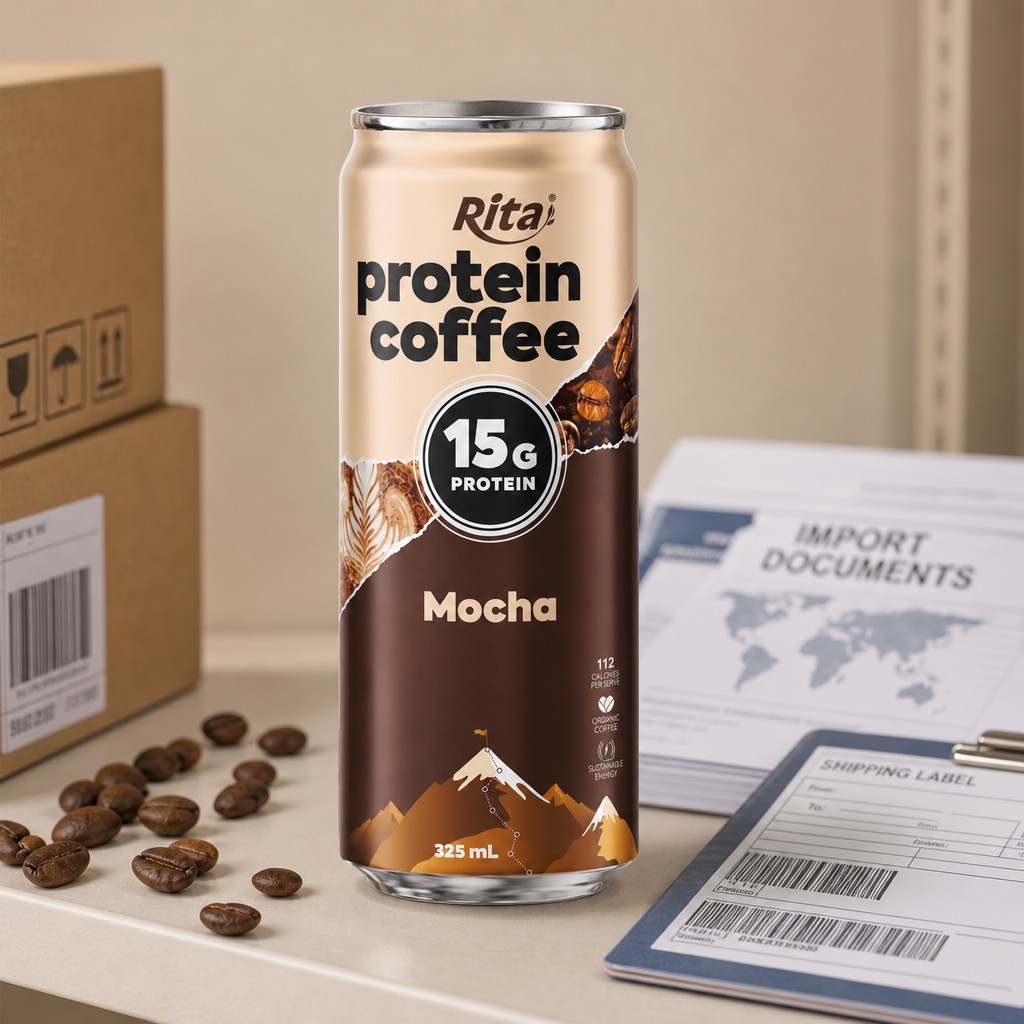
Launching a single SKU across eleven-plus national markets means navigating divergent labeling rules, import documentation regimes, cold-chain exemptions, and retailer onboarding cycles. The Rita High Protein Coffee Mocha Drink 15g Protein is engineered to sidestep several of those friction points. Its aluminum can format is shelf-stable for 24 months, eliminating refrigerated logistics from the equation. A Brix level of 14.0 ± 0.5 and pH of 6.5 ± 0.5 keep the sensory profile consistent from the first production run to the last, which matters when a retailer in Santiago and a c-store buyer in Chicago are tasting the same pallet.
Behind that consistency sits RITA Food and Drink Co., Ltd, a Vietnamese OEM/ODM manufacturer established in 2004. The company runs more than 50 automated production lines and exports over 1,200 containers monthly to 200+ countries and territories. For a buyer evaluating a private label or co-manufacturing partner for the Americas, throughput at that scale is a meaningful signal. Explore the full RITA High Protein Coffee Mocha Drink 325ml product page for packaging specifications and order details.
Product Architecture Built for Export
The formulation reads like an export checklist: shelf stability, halal and kosher compliance, and a protein claim that survives translation into Spanish and Portuguese.
Ingredient and Nutrition Profile
The drink is built on whole milk powder and milk protein concentrate, with instant coffee powder and alkalised cocoa delivering the mocha character. Sucralose and acesulfame potassium handle sweetness, keeping the can at approximately 201 kcal while preserving a full-bodied mouthfeel. The result is a beverage that lands around 15g of protein per serving with roughly 17.6g per can, a figure that reads clearly on shelf against conventional RTD lattes carrying 2-3g. For buyers comparing specifications across the broader category, the coffee drink series catalog provides a wider view of available formats.
That nutritional density is paired with a caffeine load of 91mg, roughly comparable to a standard brewed cup. The positioning is straightforward: one can, one sitting, both a coffee ritual and a protein serving in a single 325ml package.
Packaging and On-Shelf Identity
The 325ml aluminum can uses warm earthy tones of brown, beige, and cream, with a split design featuring a beige upper section and brown lower section. A central circle badges "15 G PROTEIN" in bold typography, flanked by roasted coffee bean graphics and latte art imagery. Mountain silhouettes along the base evoke outdoor and active contexts, while small icons reference sustainable energy messaging. The design brief clearly targets gym bags, office desks, and travel kits equally.
Aluminum as a substrate also matters on the supply chain side. Cans are lightweight relative to glass, stack efficiently in mixed pallets, and are widely recyclable across municipal programs in the United States, Canada, and most of Latin America. For importers calculating landed cost per unit across ocean freight legs, that density advantage compounds quickly.
Certification Stack as Market Access Infrastructure
Certifications are the passport stamps of beverage trade, and RITA's stack covers the major ones retailers ask for.
The company holds BRC, FSSC 22000, ISO, GMP, HACCP, and SMETA audits, alongside Halal Jakim and Halal HCA-GCC approvals and Kosher certification. For Central American and Mexican buyers, Halal and Kosher coverage opens channels that a single-market certification would not. For Canadian and U.S. co-pack or private label programs, BRC and FSSC 22000 are the two audit schemes most frequently named in supplier qualification questionnaires. The full OEM capability set, including private label development, is detailed on the RITA OEM service page.
What Retailers and Importers Actually Check
When a category manager in Bogotá or a distributor in Ontario evaluates a new RTD coffee SKU, the checklist tends to follow a predictable order:
- Shelf life and storage conditions (24 months, ambient)
- Certification documentation (BRC, FSSC 22000, ISO, Halal, Kosher)
- MOQ and container loading efficiency
- Label compliance for the destination market
- Sensory consistency across production lots
RITA's export footprint across 200+ countries suggests familiarity with the documentation burden that accompanies each of those checks. The company's private label program further allows a regional distributor to carry their own brand identity on a proven base formulation, shortening the path from sampling to shelf.
From Raw Materials to the Can
Traceability from ingredient origin to finished can is increasingly a procurement requirement, not a marketing line.
Source Regions Behind the Blend
Coffee inputs draw on Vietnam's own highland growing regions. RITA's team documents visits to Vietnamese coffee gardens during peak harvest season, a practice that supports lot traceability for the instant coffee powder used in the mocha blend. The company's sourcing footprint extends across the Mekong Delta for dairy and agricultural inputs as well.
The farm-to-can journey for the coffee component is covered in RITA's reporting from Vietnam's coffee gardens during peak harvest, where the team evaluates cherry quality and processing conditions before raw material enters the supply chain.
Broader agricultural inputs for the company's beverage portfolio are anchored in the Mekong Delta raw material region, which supplies a significant share of fruit and dairy-adjacent inputs across RITA's product lines.
Video documentation of the sourcing region is available here: https://www.youtube.com/watch?v=jiBixXjeG8A
Market Positioning Across the Americas
Protein-enhanced coffee is no longer a niche experiment; it is becoming a standard sub-segment of the RTD coffee category.
Across the United States and Canada, convenience formats carrying explicit protein claims have moved from natural-channel shelves into mainstream c-store and mass retail. In Latin America, the pattern is similar but compressed: Mexico, Brazil, Colombia, and Argentina are all seeing RTD coffee growth alongside rising interest in protein-forward beverages. The Rita High Protein Coffee Mocha Drink sits at that intersection, offering a mocha flavor profile that travels well across palates accustomed to both café con leche and sweetened iced coffee traditions.
Competitive Context
The competitive set includes global RTD coffee majors, regional dairy-coffee brands, and a wave of protein coffee startups. Where an OEM-backed entrant differentiates is on supply assurance rather than brand storytelling. A buyer can point to audited facilities, container-level throughput, and a 24-month shelf life when building a multi-country rollout calendar.
For distributors evaluating the category, the product listing for Rita High Protein Coffee Mocha 325ml includes the specification sheet needed for preliminary import analysis.
Operational Considerations for Regional Buyers
Three operational questions tend to decide whether a sample converts into a container booking.
MOQ, Lead Time, and Container Planning
RITA's monthly export volume above 1,200 containers implies established booking relationships with major carriers, which matters when a launch window in Q3 requires predictable sailing schedules. Private label programs add 4-8 weeks for artwork and can-end tooling, a timeline most buyers plan around rather than a constraint they treat as a surprise.
Regulatory Labeling by Destination
Each destination market imposes its own nutrition panel format, language requirement, and allergen declaration scheme. The mocha formulation contains milk-derived ingredients, which triggers mandatory allergen disclosure under Codex-aligned regimes used across most of Latin America and under FDA and CFIA rules in North America. An experienced exporter handles these variants as a standard part of order processing rather than a bespoke project.
Sensory Consistency at Volume
Specified Brix and pH tolerances are the quiet workhorses of multi-market consistency. A can opened in Guadalajara and a can opened in Toronto should deliver the same sweetness curve and mouthfeel, because consumer complaints about lot variation travel faster on social media than trade press can track.
Looking Ahead
The Americas present a rare combination for RTD coffee: established coffee culture, expanding protein beverage adoption, and logistics networks mature enough to support ambient shelf-stable formats. Products that arrive with the paperwork already in order will capture shelf space faster than those still assembling their compliance file. RITA High Protein Coffee Mocha Drink enters that race with two decades of export infrastructure behind it, a specification sheet that reads cleanly across languages, and a can format that fits the way people actually move through their day.
Distributors and private label buyers can review the complete Rita High Protein Coffee Mocha 325ml specifications and request samples through the product page.
Frequently Asked Questions
What is the protein and caffeine content of Rita High Protein Coffee Mocha Drink?
Each 325ml aluminum can contains approximately 15g of protein (about 17.6g per can depending on serving basis) and 91mg of caffeine, with around 201 kcal per can.
What certifications does the manufacturer hold for export?
RITA Food and Drink Co., Ltd holds BRC, FSSC 22000, ISO, GMP, HACCP, SMETA, Halal Jakim, Halal HCA-GCC, and Kosher certifications, supporting export to 200+ countries and territories.
What is the shelf life of the product?
The product has a 24-month shelf life as an ambient shelf-stable ready-to-drink beverage in aluminum can packaging.
Does RITA offer private label options for this coffee drink?
Yes. RITA operates OEM and ODM programs with private label support, allowing regional distributors to carry their own brand identity on the base formulation.
Which markets in the Americas is the product suited for?
The product is positioned for distribution across the United States, Canada, Mexico, Brazil, Argentina, Colombia, Chile, Peru, Ecuador, Venezuela, and Central America.


 No.08, Thong Nhat Boulevard,